

How the Investment World Has Changed — and Why Advice Must Evolve With It
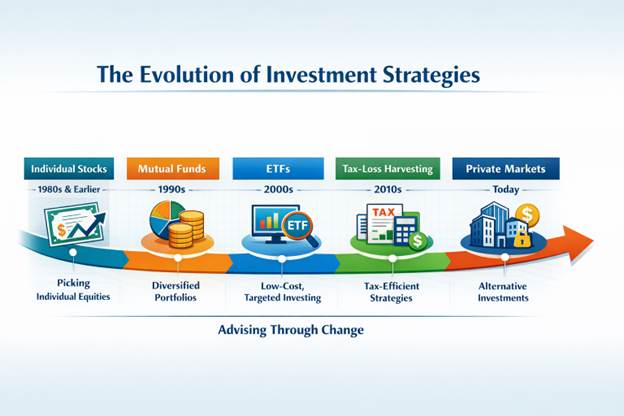
Over the past several decades, the investment landscape has undergone a profound transformation. What once revolved around selecting individual securities has expanded into a far broader ecosystem of investment vehicles, tax strategies, and portfolio construction tools. For investors, this evolution has created more opportunity—but also more complexity. For advisors, it has fundamentally changed what it means to deliver value.
The Early Era: Individual Stocks and Bonds
If you stepped back to 1985, investing primarily meant owning individual stocks and bonds. Portfolios were built security by security, with a heavy emphasis on company-specific research, dividend income, and holding periods measured in decades. The advisor (or stockbroker) had the data, the ticker tape, and access to the trading desk. You hired them to pick winners and beat the market.
This approach rewarded patience and discipline, but it also came with meaningful drawbacks:
- Heavy concentration in a small number of holdings
- High transaction costs and commissions
- Limited diversification, especially for smaller investors
Advice during this era was largely centered on security selection and market timing—often high risk, high cost, and highly dependent on a few individual bets. If your “hot stock tip” went wrong, the impact on your portfolio could be severe.
The Rise of Mutual Funds: Diversification at Scale
The widespread adoption of mutual funds marked a major shift. For the first time, investors could access diversified portfolios with a single investment. Professional management, daily pricing, and regulatory oversight made investing more accessible to households that previously lacked the scale to diversify effectively.
This era emphasized:
- Asset allocation over individual stock picking
- Long-term, buy-and-hold strategies
- Manager selection and style diversification
Advisors moved from picking stocks to picking managers. The goal was still to beat the market—generate “alpha”—but by selecting skilled professional fund managers. However, many mutual funds carried high expense ratios and were not tax-efficient. Investors often owed taxes on capital-gains distributions even if they never sold a share.
The ETF Revolution: Efficiency, Transparency, and Precision
Exchange-traded funds (ETFs) accelerated innovation even further. With lower costs, greater tax efficiency, and the ability to target specific asset classes, sectors, or investment factors, ETFs gave investors unprecedented flexibility and precision.
ETFs enabled:
- Lower expense ratios and improved after-tax outcomes
- Intraday liquidity and transparency
- More refined portfolio tilts and systematic rebalancing
As ETFs proliferated, the value of advice shifted again—away from product selection and toward implementation. The advisor’s role increasingly became about asset allocation: building and maintaining the right mix of ETFs to align with a client’s risk tolerance, goals, and time horizon.
The Tax-Aware Era: Portfolio Management Beyond Returns
As markets became more efficient, attention increasingly turned to what investors keep, not just what they earn. Systematic tax-loss harvesting, asset-location strategies, and coordinated tax planning began to materially improve after-tax results—often without changing overall market exposure.
This marked a true turning point:
- Portfolio management became continuous, not periodic
- Taxes became a core component of investment design
- Technology enabled far more precise implementation
Rather than simply owning the S&P 500 through a single fund, technology now allows investors to own the individual stocks inside it. This creates opportunities to harvest losses along the way—selling underperforming positions to offset future capital gains and improve long-term after-tax outcomes. Advisors who failed to integrate tax awareness risked leaving meaningful value on the table.
Today and Beyond: Access to Private Markets
More recently, select investors have gained broader access to private equity, private credit, real estate, and other alternative investments. These assets can offer diversification, differentiated return drivers, and inflation sensitivity—but they also introduce new considerations around liquidity, complexity, and risk.
Modern portfolios may now include:
- A blend of public and private investments
- Longer-term capital commitments
- Greater customization based on investor goals and constraints
As public markets have become more efficient—and more crowded—the search for return has increasingly moved into private markets. New structures such as interval funds and semi-liquid vehicles have begun to open these opportunities to individual investors, expanding the toolkit available to thoughtful portfolio design.
What This Means for Financial Advice
As investment products have evolved, so too must the advisor. Today, value is no longer found in simply selecting investments. It comes from orchestrating a comprehensive financial strategy—one that integrates portfolio construction, tax planning, cash-flow management, and long-term goals.
A modern advisor must:
- Adapt to new tools and technologies
- Continuously evaluate emerging investment opportunities
- Balance innovation with discipline and risk management
- Translate complexity into clarity for clients
The investment world has moved from a grocery store—where you picked individual ingredients—to a restaurant, where the value lies in a thoughtfully designed meal. The advisor is the chef: designing the menu, managing the kitchen, and ensuring the outcome fits your preferences, needs, and long-term health.
Markets will continue to change. New products will emerge. Surprises are inevitable. The constant, however, is the need for thoughtful, adaptive advice—grounded in experience, guided by evidence, and tailored to each investor’s unique circumstances.
DISCLAIMER: Past performance may not be indicative of future results. Different types of investments involve varying degrees of risk, and there can be no assurance that the future performance of any specific investment, investment strategy, or product made reference to directly or indirectly in this newsletter (article), will be profitable, equal any corresponding indicated historical performance level(s), or be suitable for your portfolio. Due to various factors, including changing market conditions, the content may no longer be reflective of current opinions or positions. Moreover, you should not assume that any discussion or information contained in this (article) serves as the receipt of, or as a substitute for, personalized investment advice from Elmwood Wealth Management. A copy of our current written disclosure statement discussing our advisory services and fees is available for review upon request.